
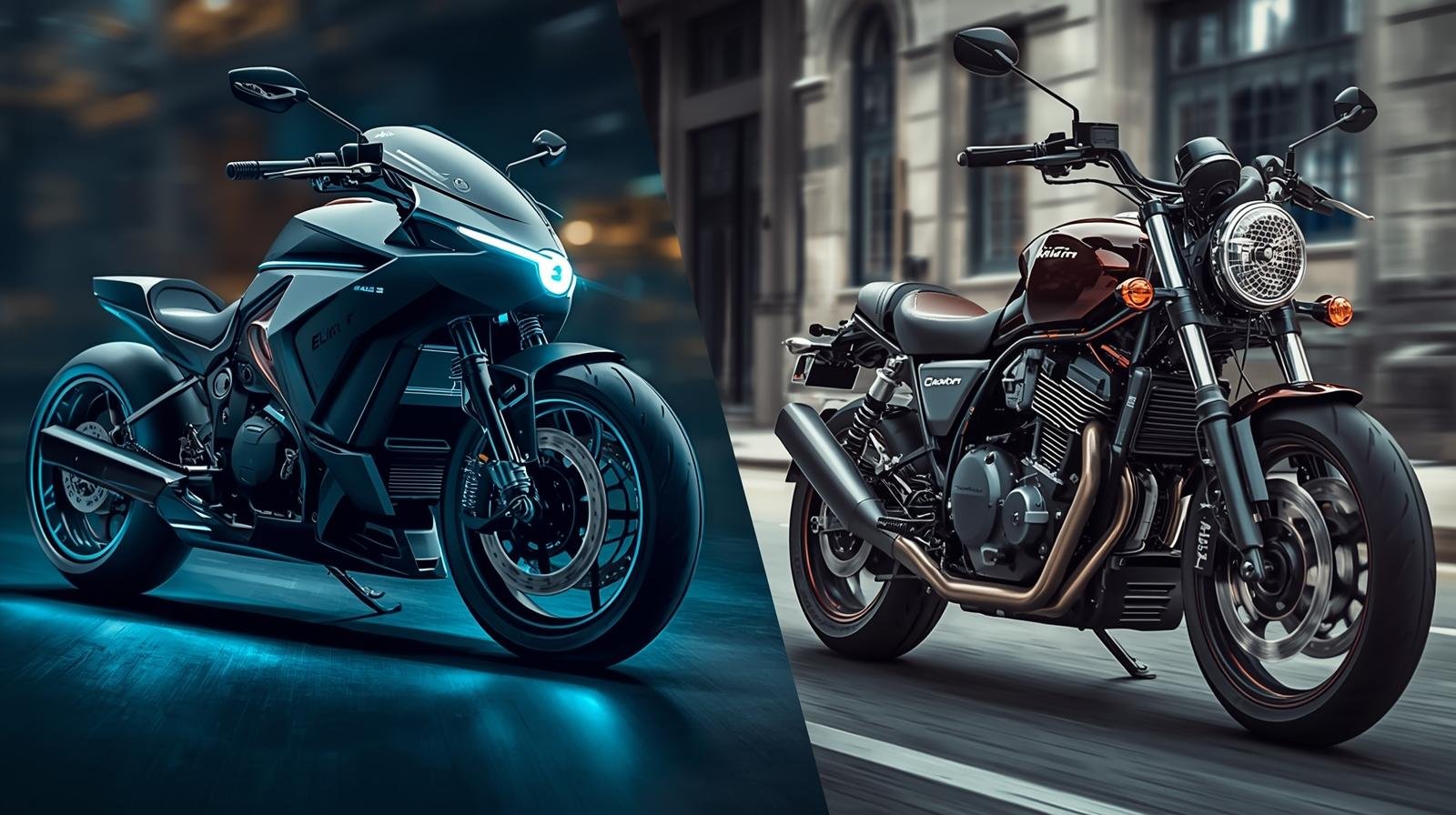
There has never been a more interesting time to be shopping for a motorcycle. For the first time in over a century of motorcycling history, buyers face a genuine fork in the road — not just between different styles or brands, but between two fundamentally different technologies that represent two very different visions of what motorcycling is and where it is heading. Electric bikes and petrol bikes each have passionate advocates, each offers real and compelling advantages, and each comes with trade-offs that matter differently depending on who you are and how you ride.
The electric versus petrol debate in the motorcycle world is more nuanced and more interesting than it is often portrayed. It is not simply a question of which technology is newer or which is more environmentally friendly. It is a question of what riding actually means to you, where you ride, how far you travel, what you can afford, and what kind of ownership experience you want to have day after day. Neither technology is universally better than the other in 2026, and anyone who tells you otherwise is oversimplifying a genuinely complex picture.
This guide cuts through the noise with honest, balanced, and practical analysis that helps you make the right choice for your specific situation.
The State of the Electric vs Petrol Debate in 2026
The conversation between electric bikes and petrol bikes has evolved considerably from just a few years ago, when electric motorcycles were still widely regarded as interesting experiments rather than serious alternatives to established petrol machines. In 2026, that perception has shifted substantially, and the shift is justified by genuine improvements in electric motorcycle technology, battery range, charging infrastructure, and the breadth of models available across price points and riding categories.
Electric motorcycle sales have grown significantly year on year across most major markets, and the quality gap between electric and petrol machines that once made the comparison feel somewhat academic has narrowed to the point where it is now a genuinely meaningful choice rather than a theoretical one. Riders in urban environments, commuters with predictable daily distances, and technology-forward buyers have adopted electric motorcycles in growing numbers, and their real-world ownership experiences are informing the broader conversation in ways that manufacturer marketing campaigns cannot.
At the same time, the petrol motorcycle has not stood still. Modern petrol engines are cleaner, more efficient, and more refined than at any point in their history. Fuel injection, advanced emission control systems, and sophisticated electronics have produced petrol motorcycles that bear little resemblance to the carburettored machines of a generation ago in terms of their environmental impact and operational sophistication. The petrol bike remains the choice of the majority in 2026, and for many riders, it remains the better choice for reasons that have nothing to do with nostalgia.
Understanding both technologies honestly, with their genuine strengths and their real limitations, is the foundation of making a good decision.
Running Costs: Where Electric Bikes Win Clearly
If you are looking for a clear, unambiguous area where electric bikes outperform petrol bikes in 2026, running costs are where you will find it. The economics of electric motorcycle ownership are genuinely and significantly better than petrol ownership across almost every measure of ongoing expenditure, and this advantage compounds over time in a way that makes the total cost of ownership calculation increasingly favour electric as ownership duration increases.
The energy cost comparison is the most striking element. Charging an electric motorcycle from a domestic power outlet costs a fraction of the equivalent petrol expenditure for the same distance covered. The exact figure varies between markets depending on electricity and petrol prices, but in most developed countries, the cost per kilometre of electric motorcycle travel is between five and ten times lower than the equivalent petrol cost. Over a year of daily commuting, this difference translates to hundreds of dollars in direct savings that put real money back in the rider’s pocket.
Maintenance costs add another layer to the electric advantage. An electric motorcycle has dramatically fewer moving parts than a petrol machine. There is no engine oil to change, no oil filter, no air filter, no spark plugs, no fuel injectors, no cooling system requiring periodic attention, and no exhaust system to service or replace. The electric motor itself requires essentially no maintenance over its operational life. The components that do require attention — brakes, tyres, and the chain or belt drive if fitted — are the same as on any motorcycle and require the same periodic replacement.
Battery replacement is the main long-term cost concern for electric motorcycle owners, and it is a legitimate one. Lithium-ion batteries degrade gradually over charge cycles and years of use, and eventually they will need to be replaced at a cost that represents a significant expense. However, battery technology has improved substantially, and modern electric motorcycle batteries are designed and warranted to retain meaningful capacity over many years of regular use. The timeline before battery replacement becomes necessary has extended significantly from earlier electric vehicles, and for many riders in 2026, the battery question remains a future concern rather than an immediate one.
Range and Practicality: Where Petrol Bikes Hold the Advantage
Honest assessment of the electric versus petrol comparison requires acknowledging clearly that range and refuelling convenience remain areas where petrol bikes hold a genuine and meaningful advantage in 2026, and that this advantage matters substantially for certain riders and riding styles.
A modern petrol motorcycle with a standard-sized fuel tank can typically travel between 200 and 400 kilometres before needing to refuel. Refuelling takes approximately three to five minutes at any of the petrol stations that exist in virtually every settlement of any size across the developed world and in most of the developing world. The range anxiety that this system creates is minimal because the infrastructure for extending range is universally available, the process is fast and simple, and the additional range provided is immediately and completely restored.
Electric motorcycles in 2026 have improved their real-world range significantly compared to earlier generations, and the best current models offer genuine ranges of 150 to 250 kilometres under real-world mixed riding conditions. For urban commuters whose daily distance falls well within this range and who can charge at home overnight, this is entirely sufficient, and the range question is practically irrelevant. For these riders, they simply plug in each evening and start every day with a full charge, which is actually more convenient than visiting a petrol station.
For riders who tour long distances, travel through areas with limited charging infrastructure, or face unpredictable day-to-day distances that occasionally exceed typical electric range, the picture is more complicated. Fast charging technology has improved and can bring many electric motorcycles to 80 percent capacity in 30 to 60 minutes using compatible rapid chargers, but this is still significantly longer than a petrol refuel. Public charging infrastructure, while expanding rapidly in most developed markets, remains uneven in coverage and reliability compared to the petrol station network built over many decades. In rural areas, remote regions, and most of the developing world, charging infrastructure remains genuinely limited.
This practical reality means that for long-distance touring riders, adventure riders who venture into remote areas, and riders in markets with limited charging networks, petrol remains the more practical choice in 2026 for straightforward operational reasons rather than preference or ideology.
Performance and the Riding Experience: A Genuine Comparison
The riding experience question is perhaps the most subjective but also the most genuinely interesting dimension of the electric versus petrol comparison, because the two technologies offer fundamentally different sensory and dynamic experiences that appeal to different riders for different reasons.
Electric motorcycles deliver their torque instantly and completely from zero revolutions. There is no power curve to manage, no need to be in the right gear, and no waiting for the engine to build revs before meaningful acceleration is available. The result is an acceleration experience that is uniquely immediate and forceful, particularly from rest and in the lower speed ranges where electric torque is at its most impressive. Riders who experience this for the first time often describe it as genuinely surprising, and the smoothness of the acceleration adds a quality to the experience that is difficult to achieve with a petrol engine.
The absence of engine sound is a dimension of electric riding that divides opinion strongly. For some riders, riding in relative silence feels peaceful, refined, and appropriate for urban environments where mechanical noise contributes to the stress of the riding context. For others, the sound of a well-tuned petrol engine is an integral part of the motorcycling experience, communicating information about engine state and adding an emotional dimension to the ride that silence cannot replicate. This is not a trivial preference — many experienced riders genuinely find that electric motorcycles feel less engaging and emotionally satisfying precisely because the auditory feedback that they have always associated with riding is absent.
The vibration and mechanical character of a petrol engine, which many riders experience as part of the personality of their motorcycle, is also absent in electric machines. The smoothness of electric power delivery, which is a genuine advantage in urban commuting, becomes, for some riders on longer journeys, a form of sensory monotony that feels less connected and less involving than a petrol-powered riding experience.
Neither experience is objectively superior. They are genuinely different, and your preference between them is a legitimate and important factor in deciding which technology suits you better.
Environmental Considerations: A Nuanced Picture
The environmental comparison between electric bikes and petrol bikes is more nuanced than popular discourse typically acknowledges, and understanding the full picture helps you make a more informed decision if environmental impact matters to your choice.
Electric motorcycles produce zero direct emissions at the point of use, which is genuinely and meaningfully better than a petrol motorcycle in terms of local air quality, particularly in urban environments where vehicle emissions directly affect the health of urban populations. This is a real and significant advantage that should not be dismissed.
The full lifecycle environmental picture is more complex. The manufacturing of electric motorcycle batteries requires mining and processing of lithium, cobalt, and other materials with their own environmental footprints. The electricity used to charge electric motorcycles comes from energy grids that in many markets still include substantial portions of fossil fuel generation, which means the emissions are displaced rather than eliminated. In markets where the electricity grid is powered predominantly by renewable sources, the environmental advantage of electric motorcycles is very substantial. In markets where the grid is predominantly coal-powered, the advantage narrows significantly.
Modern petrol motorcycles, particularly smaller-displacement commuter bikes, produce a relatively modest amount of carbon dioxide per kilometre compared to cars and larger vehicles. A fuel-efficient 125cc commuter motorcycle has a carbon footprint that compares reasonably well with electric alternatives in markets with less clean electricity grids when the full lifecycle is considered.
The honest conclusion is that in most developed markets with moderately clean electricity grids, electric motorcycles do offer genuine environmental advantages over petrol alternatives, but the margin is smaller than zero-emission-at-point-of-use figures suggest. In markets with very clean grids, the advantage is substantial and clear.
Purchase Price and Availability: Petrol Holds the Practical Advantage
In terms of purchase price and the breadth of available options across price points, riding styles, and market availability, petrol motorcycles hold a clear advantage in 2026 that is unlikely to close entirely for several more years.
Entry-level petrol motorcycles are available at price points well under one thousand dollars in many markets for used examples, and new petrol commuter bikes in the 125cc to 250cc class are widely available in most markets for between one thousand and four thousand dollars. This price accessibility has no equivalent in the electric motorcycle market, where even the most affordable new electric motorcycles typically start at three to four thousand dollars minimum in markets where they are available, and premium electric performance machines cost considerably more than their petrol equivalents.
The used electric motorcycle market is also considerably thinner than the used petrol market, which reflects the shorter history of electric motorcycle production and the additional uncertainty buyers feel about battery condition in used electric vehicles. For buyers who rely on the used market to access motorcycles within their budget, petrol remains the vastly more practical option in 2026.
Electric vs Petrol Quick Comparison for 2026
Running costs: Electric wins clearly, significantly lower fuel and maintenance costs
Range and refuelling: Petrol wins, faster refuelling, better infrastructure coverage
Performance character: Different rather than better or worse, instant electric torque vs petrol engagement
Environmental impact: Electric is generally better in clean grid markets, a more complex picture otherwise
Purchase price: Petrol wins, significantly wider range of affordable options
Availability and choice: Petrol wins, vastly greater model range across all categories
Long-distance touring: Petrol wins for remote and international touring
Urban commuting: Electric wins for daily city use within range parameters
Maintenance simplicity: Electric wins, fewer components requiring attention
Practical Tips for Making the Right Choice
Be honest about your actual riding patterns rather than your aspirational ones. If you ride predominantly in urban environments, cover a predictable daily distance, have access to home charging, and your primary use case is commuting, electric is likely the better practical choice for your situation. If you ride long distances, tour extensively, ride in areas with limited charging infrastructure, or your daily distances are variable and potentially long, petrol remains the more appropriate practical choice.
If you are seriously considering an electric motorcycle, research the charging infrastructure in your specific area before purchasing, not after. The density and reliability of public charging points vary enormously between cities, regions, and countries, and the practicality of electric motorcycle ownership depends significantly on whether adequate charging facilities exist where you live, work, and ride.
Test ride both technologies before making a decision. Reading about the different riding experiences of electric and petrol motorcycles cannot adequately communicate the genuine sensory difference between them. Many dealers in both categories will arrange demonstration rides, and experiencing both firsthand allows you to make an informed preference rather than a theoretical one.
Consider the total cost of ownership over your expected ownership period rather than just the purchase price. When you factor in fuel savings, reduced maintenance costs, and potential government incentives for electric motorcycle purchase over a three to five-year ownership period, the higher initial purchase price of many electric motorcycles can be partially or fully offset, making the true financial comparison more favourable to electric than the sticker price comparison suggests.
Frequently Asked Questions
Is an electric bike cheaper to run than a petrol bike in 2026?
Yes, in virtually all markets where both are available. The energy cost per kilometre of electric motorcycle travel is significantly lower than equivalent petrol costs, and the reduced maintenance requirements of electric drivetrains add further ongoing savings. The total cost advantage of electric over petrol running costs is one of the clearest and most consistent findings in real-world ownership comparisons in 2026.
How long does it take to charge an electric motorcycle?
Charging time depends on the battery size, starting charge level, and charger type. Standard home charging overnight on a domestic outlet typically takes six to eight hours for a full charge. Rapid DC fast charging at compatible stations can bring most current electric motorcycles to 80 per cent capacity in 30 to 60 minutes, depending on the specific model and charger capability.
Are electric motorcycles suitable for beginners?
Yes, and in some respects they are particularly suitable. The smooth, progressive power delivery of electric motors is more manageable for new riders than the potentially abrupt power delivery of some petrol engines. The absence of clutch and gear operation on most electric motorcycles reduces the coordination demands placed on new riders, allowing more focus on balance, traffic awareness, and basic control skills.
Can you ride an electric motorcycle in the rain?
Yes. All production electric motorcycles are designed and tested for normal wet-weather riding, and their electrical systems are appropriately sealed against moisture encountered in regular riding conditions. Standard rain riding presents no additional safety concern for electric motorcycles compared to petrol machines. Submersion in deep water is a different matter, as it would be for any motorcycle.
Which is better for long-distance touring in 2026, electric or petrol?
For most long-distance touring scenarios, particularly those involving remote areas, international travel, or routes through regions with limited charging infrastructure, petrol remains the more practical choice in 2026. The combination of faster refuelling, universally available fuel infrastructure, and longer practical range gives petrol a genuine operational advantage for extended touring that the current state of electric charging infrastructure cannot yet fully match.
Conclusion
The electric bikes versus petrol bikes debate in 2026 does not have a single correct answer, and anyone who tells you it does is either selling something or oversimplifying a genuinely complex comparison. Both technologies offer real and meaningful advantages. Both come with genuine trade-offs that matter differently depending on how, where, and why you ride.
Electric motorcycles are the better choice in 2026 for daily urban commuters with predictable distances, access to home charging, and a priority on low running costs and minimal maintenance. The financial case for electric vehicles in these circumstances is strong and getting stronger every year as battery technology improves and charging infrastructure expands.
Petrol motorcycles remain the better choice in 2026 for long-distance tourers, riders in areas with limited charging infrastructure, buyers with limited purchase budgets who need to access the used market, and riders for whom the sound, character, and sensory experience of a combustion engine is a fundamental part of what motorcycling means to them.
The most important insight in the electric versus petrol comparison is this: know yourself as a rider, be honest about your actual needs rather than your theoretical ones, and choose the technology that serves your real life most effectively. Both are legitimate, both are enjoyable, and both will take you somewhere worth going.


Leave a Reply